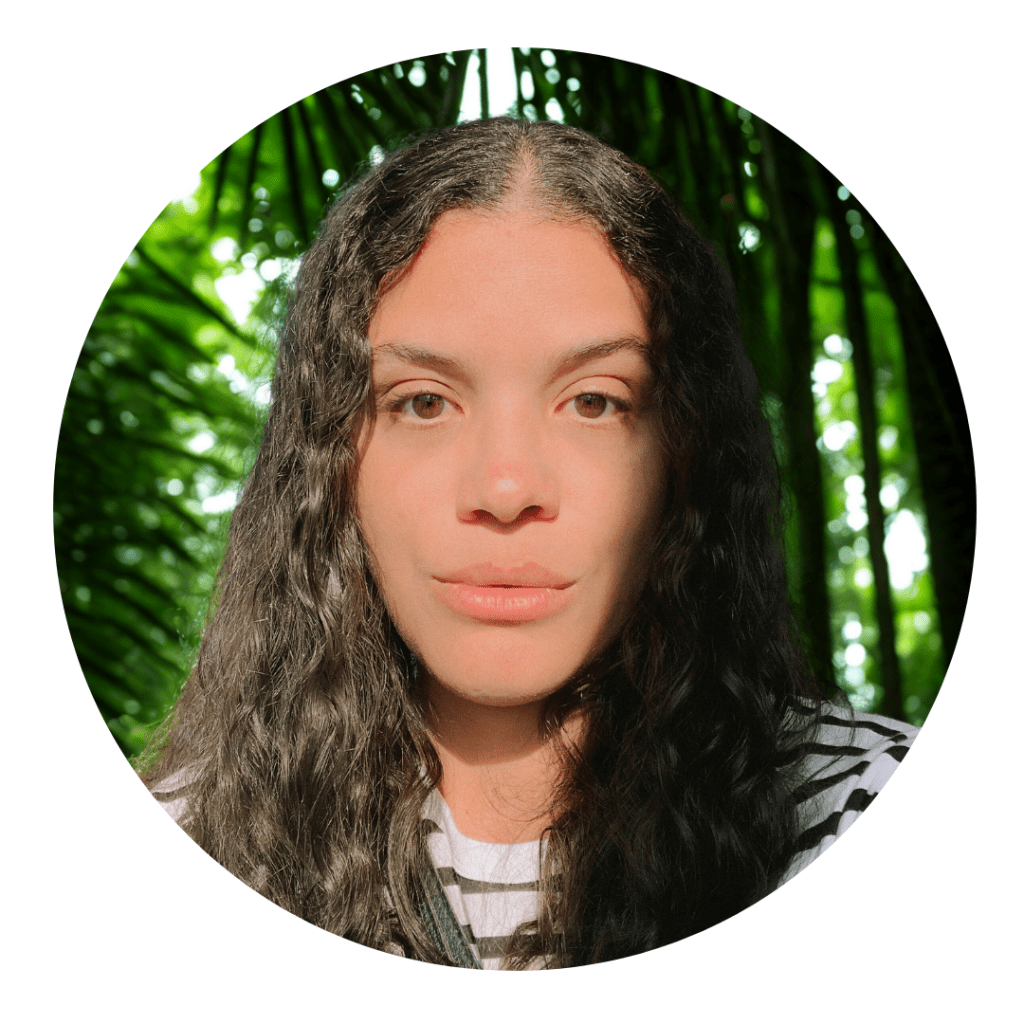
Project Manager
Anissa Martins Peralta is a Brazilian artist, researcher, and arts educator based in Halifax, Canada. She is currently pursuing a Master’s in Art Education at NSCAD University. With a background in Arts & Crafts, Graphic Design, and International Relations, her practice centers on intersectionality, memory, decolonial narratives, and textile-based art.
Anissa’s creative and pedagogical work weaves together sensory experiences, community engagement, and ancestral knowledge, often rooted in her mixed heritage of Guarani Indigenous, Black, and European descent. She explores embroidery, crochet, and other tactile materials as tools of resistance and storytelling, particularly uplifting the voices and experiences of Black, Indigenous, and Women of Color (BIWOC).
She first joined the Land Connects Us project as a Research Assistant and now serves as its Project Manager. Led by Professor Joshua Schwab-Cartas, this international initiative fosters cultural exchange and Indigenous solidarity through collaborative activities across Mexico, Atlantic Canada, Indigenous territories, and digital platforms. In her current role, she coordinates partnerships, communications, and community engagement.
Anissa is also a Research Assistant for the Design and Visual Narratives project, affiliated with the Institute for Art, Community, and Transdisciplinary Studies (InACTS) at NSCAD. Under the supervision of Dr. April Mandrona (NSCAD) and Shakara Russell (Dalhousie University), she contributes to the development of visual methodologies and community-based storytelling practices.
In addition to her research, Anissa has supported public engagement at the Mount Saint Vincent University Art Gallery and volunteered with organizations such as Alumni Canada-Brazil and SEBRAE, helping bridge visual communication with public education.
Her recent contributions, including the exhibition Reconnecting to the Land trough Urban Gardens,Travelling Images: Mi’kma’ki , and Xandú: Honoring Our Ancestors, participation in conferences, and co-authored publications—reflect her commitment to collaborative, intercultural, and decolonial approaches to art. Through her work, Anissa continues to create spaces for relationality, memory, resistance and, spaces of visibility, care, and connection, where art becomes a vehicle for healing, remembrance, and transformation.
 Land Connects Us